The panel for one run of an agent, laid out like any calm panel in an app: its name, a status line with a lamp, the state in words and the time it has been going, and a Stop key. Under it the plan as plan steps, and under that the tool calls as a plain list of the kit’s tool-call rows. Nothing is printed or torn off. The running lamp breathes by opacity alone and rests while the panel is off screen.
Seats open in 11 days. Want one email that morning?
Anatomy
A heading line, the plan steps and a list of the kit’s tool calls with the ticket’s perforation and shadow taken off, so they sit as rows with a hairline between. It has no surface of its own: it sits in whatever panel it is put in.
Variants
Running
Finished
Failed
Stopped
Narrow
States
Running
Finished
Failed
Stopped
Props and options
Name
Kind
Description
button[data-agent-stop]
element
Stop.
stopAgentRun(run)
function
Move the run to a state; or stop it, which also marks the running step and tool calls stopped.
The markup, the status in words, the clock, and the sentence said when the state changes.
Usage notes
Press Start a run: the plan and the tool calls move on, and the clock runs. Press Stop at any point: the clock stops, the step and the tool calls still running are marked stopped, and the key says so. Start again to replay it.
Accessibility
It is a named section with a heading, and it reads top to bottom: the status, the Stop key, the plan, then the tool calls.
A change of state is said once, politely.
Stop is a key with a name. Stopping marks the step and the tool calls that were running as stopped, in words.
The running lamp breathes by opacity and nothing else, rests while the panel is off screen, and under reduced motion does not breathe at all. The clock stops ticking while the panel is off screen and catches up when it is seen, since it is computed from the start time.
The tool calls are the kit’s own, a list that opens one row at a time, each with its state in words.
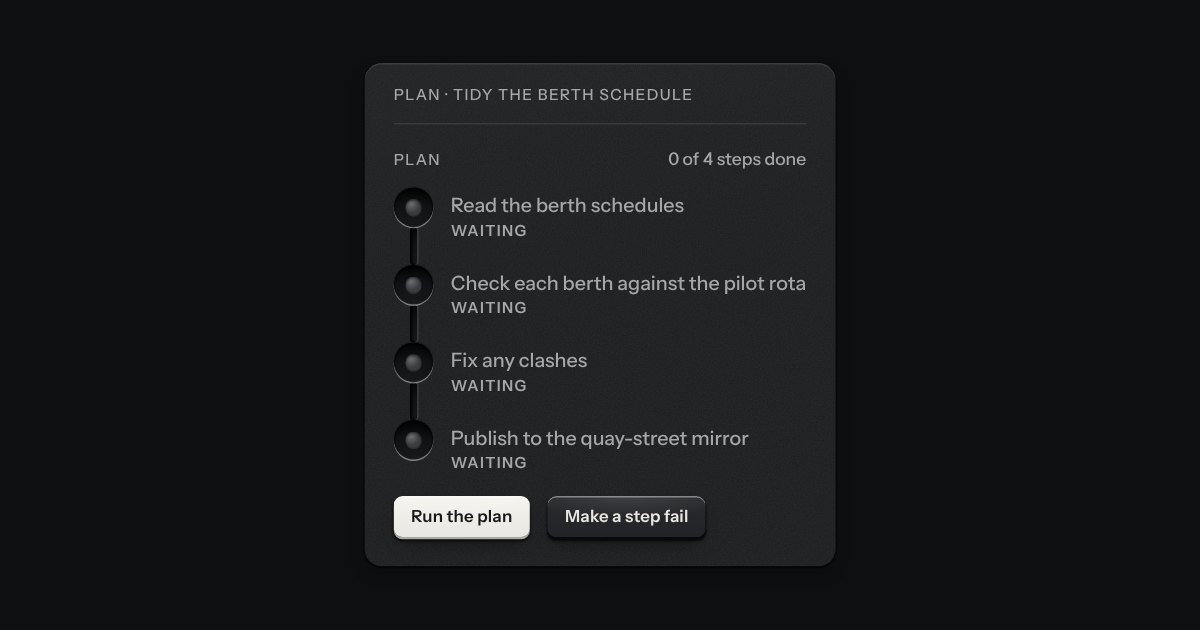
An agent’s plan as checked steps down a groove, with the pipeline’s stations stood on end. Each step is a socket with a lamp in it (green for done, amber and breathing for the one running, red for failed, an empty socket for waiting), the step in a sentence, its state in a printed word, and one line of what came of it. Ink runs down the groove as far as the plan has got. A step that was running when someone stopped the plan says Stopped.
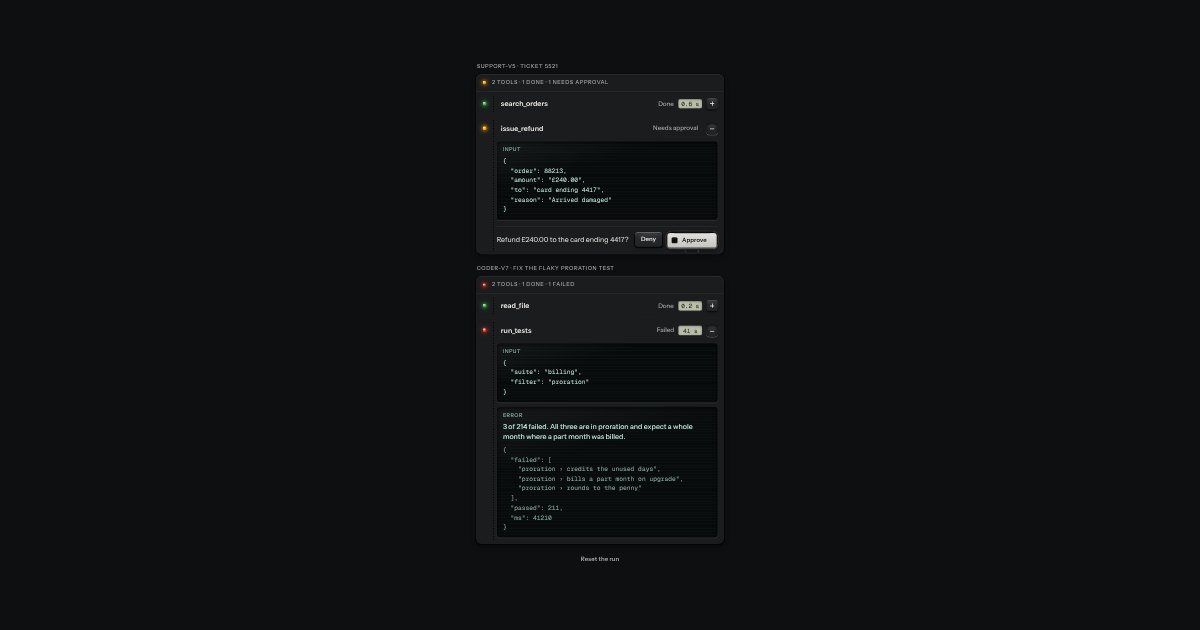
A job ticket for each tool an agent runs: the tool’s name printed as a legend, a lamp on the stub, the state in words and the time on a small LCD. Its input and output sit on display glass behind a hinge, and when the tool needs your say, Deny and Approve stand at its foot.
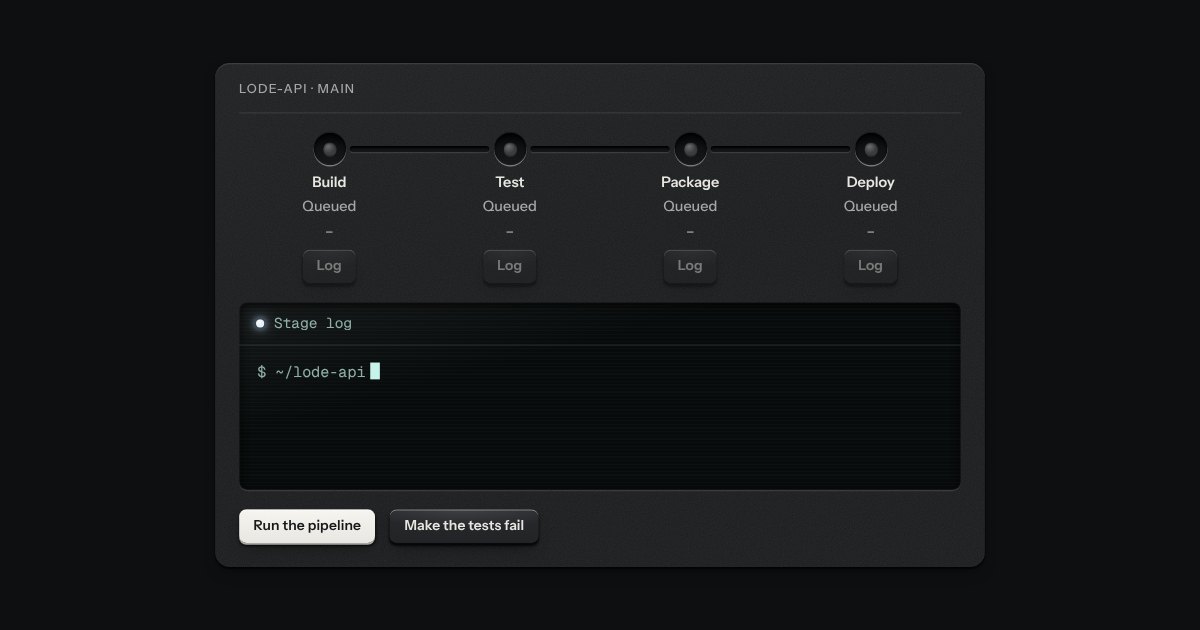
The stages of a build and a deploy as stations along a groove, like the program track of a machine. Each station is a socket with a lamp in it (green for a stage that passed, red for one that failed, amber and breathing for the one running, an empty socket for one that is waiting or was skipped) and under it the stage’s name, its state in words, how long it took and a Log key. Ink runs along the groove as far as the run has got. Wide, the stages stand in a row; narrow, they stand in a column with the groove down the side.